
The Science of Holotropic Breathwork: What It Does, How It Works, and Why It’s Central to Our Transformational Retreat
On the growing science of how our bodies hold what our minds can’t fully process - and a somatic practice that helps women release it.
There’s a concept that has moved from the margins of psychology into mainstream neuroscience over the past two decades: that our bodies don’t just experience emotions - they store them. The tension you carry in your shoulders, the tightness in your chest before a difficult conversation, the way your stomach drops when something feels off. They are your nervous system holding a record of what you’ve lived through.
Psychiatrist Bessel van der Kolk’s research, spanning more than three decades, has shown that traumatic and overwhelming experiences leave traces not just in our memories but in our biology; reshaping the brain’s wiring in areas dedicated to pleasure, engagement, control, and trust. His work helped establish what somatic therapists and body-oriented practitioners have long observed: that some experiences can’t be fully processed through thinking and talking alone. They need to be processed through the body.
Peter Levine, the developer of Somatic Experiencing®, built an entire therapeutic framework around this idea. His research, published in Frontiers in Psychology, documents how unresolved stress gets stored as nervous system dysregulation: incomplete fight-or-flight responses that remain “charged” in the body long after the original event has passed. The therapeutic path, in his model, runs through the body: directing attention to internal sensations, allowing stored energy to discharge, and restoring the nervous system’s natural capacity to regulate itself.
This is the scientific foundation that informs why we incorporate holotropic breathwork into The Catalyst Retreats. It is a deliberate somatic practice rooted in a growing body of evidence about how we process, hold, and release what we’ve experienced.
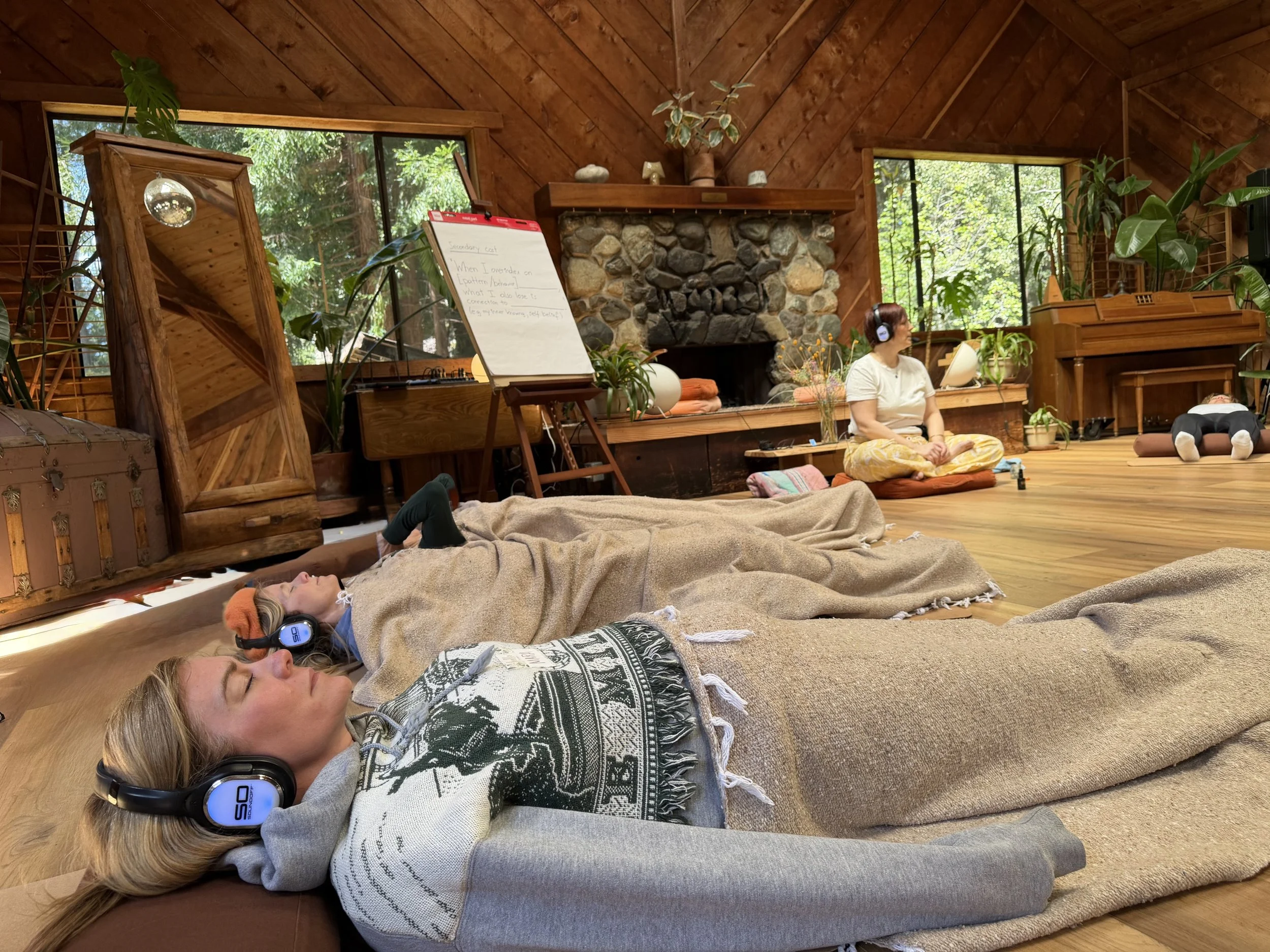
Breathwork Session led by Eva Kornet at The Catalyst West Coast Retreat
What Is Holotropic Breathwork?
Holotropic breathwork was developed in the mid-1970s by psychiatrist Stanislav Grof and his wife Christina at the Esalen Institute in Big Sur, California. Grof, a Czech-born researcher who had spent years studying non-ordinary states of consciousness in clinical settings, was looking for ways to access expanded awareness without pharmacological substances. The word holotropic comes from the Greek holos (whole) and trepein (to move toward) - literally, moving toward wholeness.
The practice involves sustained, intentional deep breathing - faster and deeper than your normal rhythm - supported by evocative music, within a safe, facilitated container. Your body leads. Your breath does the work.
The Science: What Breathwork Does to the Brain and Body
When you engage in sustained, intentional overbreathing, several measurable physiological changes occur:
Your blood chemistry shifts. Deep, rapid breathing lowers CO₂ levels, creating respiratory alkalosis. This change in blood pH directly affects neuronal excitability throughout the brain. A 2023 review in Neuroscience & Biobehavioral Reviews documented how these shifts influence sympathetic nervous system activation, cerebral blood flow, and neuronal communication patterns.
Blood flow to specific brain regions changes. A 2025 study published in PLOS ONE found that high-ventilation breathwork alters perfusion in the posterior insula and the amygdala-hippocampal region — areas involved in processing fear, emotional memory, and interoception (our sense of what’s happening inside the body). The researchers noted these changes parallel patterns observed with certain psychedelic compounds, suggesting breathwork may access overlapping neural pathways through an entirely different, non-pharmacological mechanism.
The brain’s internal predictions get disrupted. Your brain constantly forecasts what’s happening inside your body. When breathwork dramatically alters those internal signals, researchers believe the resulting “interoceptive prediction errors” may open a window for genuine shifts in perception and self-awareness. This mechanism may help explain how breathwork can produce altered states of consciousness and the deep emotional release that participants frequently describe.
Holotropic Breathwork Research: What the Studies Show
The clinical research on holotropic breathwork is still growing. Johns Hopkins psychiatry professor Matthew Johnson has noted that much of the historical evidence has been anecdotal rather than institutional. He is now leading a first-of-its-kind study examining breathwork’s potential impact on PTSD in veterans; a sign of increasing scientific attention to the practice.
The existing studies are small but suggestive. A pilot study found that participants experienced positive changes in temperament and increased self-awareness after just four breathwork sessions. A 2021 study in the Journal of Psychedelic Studies found that a single holotropic breathwork session was associated with increased life satisfaction, reduced stress, and improved non-judgment. These benefits persisted at a four-week follow-up. And over a twelve-year period at a psychiatric facility in St. Louis, approximately 11,200 patients participated in holotropic breathwork sessions with no reported adverse reactions across a range of clinical populations.
The science is early, but it’s building and it’s beginning to catch up with what practitioners and participants have been observing for decades.
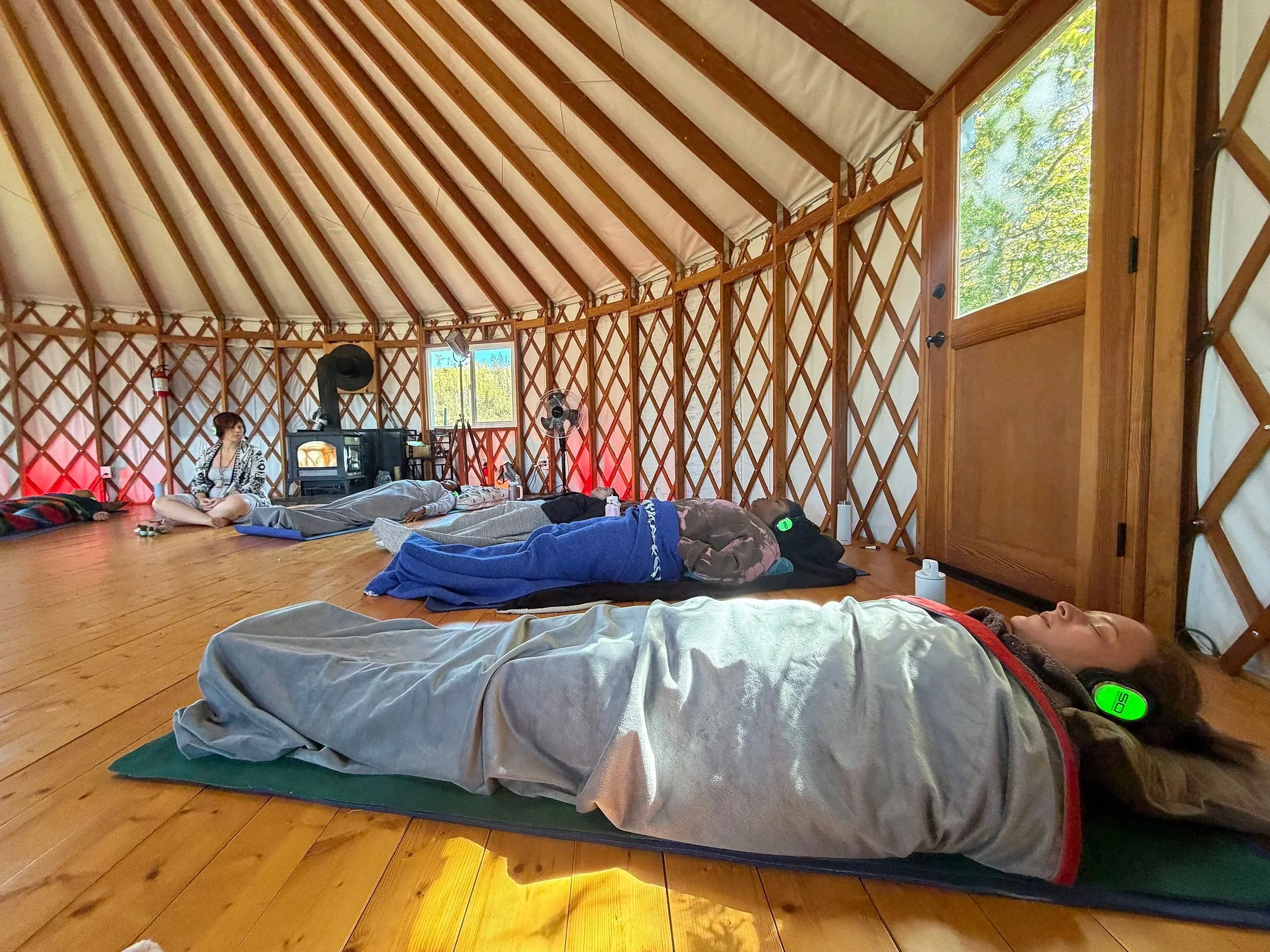
Breathwork Session led by Eva Kornet at The Catalyst East Coast Retreat
Breathwork and Coaching: How We Designed Our Women’s Retreat Experience
At The Catalyst, we don’t ask you to abandon your analytical mind. We honor it and start there - with curated coaching exercises, guided inquiry, and structured reflection that help you name what’s true: the patterns that once served you but no longer do, the strengths you’ve set aside, the things you’ve been too busy to listen to.
Then we invite you to drop into your body.
The breathwork is placed deliberately within our signature retreat sequence - after the analytical coaching work, after you’ve identified the questions that matter and built a framework around them. The holotropic breathwork session then allows those insights to move from understanding into something felt and embodied. It’s the difference between knowing you need to release a pattern and feeling it actually let go.
It can be an intense experience. You may feel tingling, waves of unexpected emotion, tears that come without a clear story attached. Many women describe it as the moment the retreat shifts from being informative to being something deeper. The coaching gives you language and clarity. The breathwork gives you access to what lives beneath that — the stored emotions, the held tension, the wisdom of a body that has been keeping its own kind of score.
You are always in control. You set the pace of your own breath, and you can adjust or stop at any point. That agency is part of what makes this practice distinct.
An Invitation
If you’re curious about holotropic breathwork and how it fits within a broader experience of coaching, self-discovery, and somatic practice, we welcome your questions. Our West Coast Catalyst Retreat takes place in the coastal redwoods of Mendocino, Northern California — a setting designed for the kind of deep, quiet work that this practice supports.
Next retreat:📍 Salisbury, CT 🗓️ September 25-28, 2026
Feel free to reach out to us directly on thecatalystretreat@gmail.com. We’re always happy to talk through any questions about the retreat and whether it might be a fit for where you are right now.